
For me, the best nonfiction does more than inform. It moves and challenges. It’s nuanced and layered, and its cost of entry is self-reflection. You cannot step inside it without accepting that you might leave the experience changed.
To date, these are the best nonfiction books I’ve ever read. No particular topic, no themes. Some are on the romantic, lyrical side. Some are more practical or functional, at least on the surface. But altogether, these are the nonfiction books that most altered how I move through the world.
All the Living and the Dead by Hayley Campbell
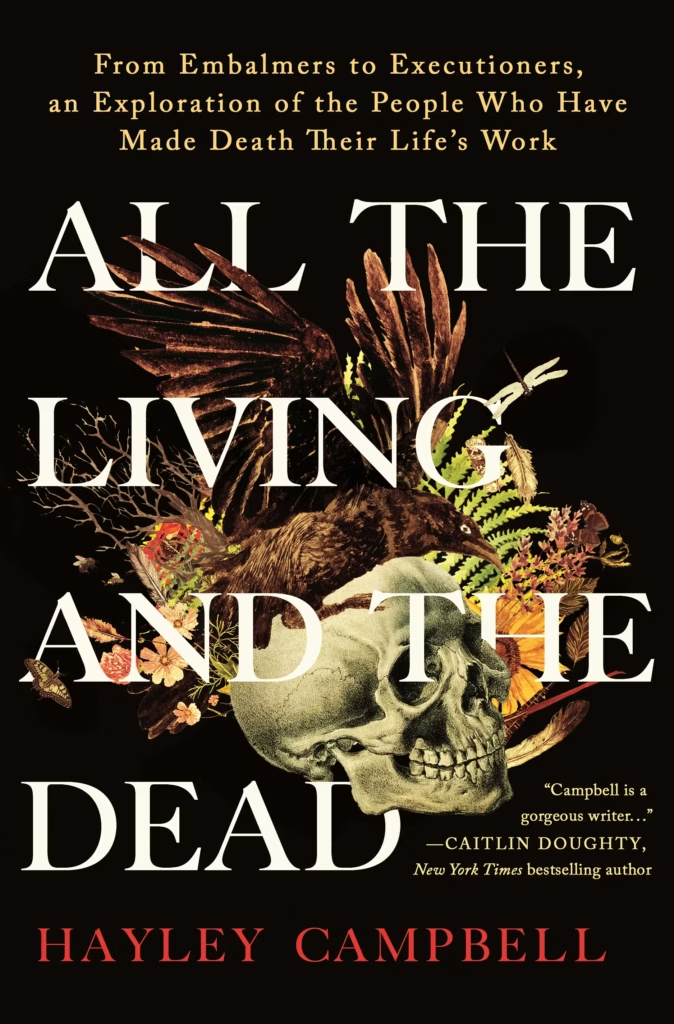
Just before this book, I had read Caitlin Doughty’s From Here to Eternity: Traveling the World to Find the Good Death. I love Doughty’s work, especially the first season of the podcast “Death in the Afternoon.” I’m so grateful to it for introducing me to the Order of the Good Death. But as entertaining as her book was, I felt afterward that I was hunting for something more introspective, atmospheric, challenging. I found what I was looking for (and more) in Campbell’s book.
As a journalist and human, Campbell explores the complex death industry. She recounts interviews with morticians, executioners, and crime scene cleaners. She interrogates how these professionals handle death. In doing so, she also interrogates her own relationship with death and the dead.
The prose is exquisite. The critical thinking has a deeply journalistic nature: candid, careful analysis of every layer of meaning. Campbell is as unflinching with her case studies as she is with herself, laying bare how these experiences affect her.
When my mom died, her wishes and my wishes clashed a bit with local social norms. I was fortunate that this clash was all tangled up with love and good intentions, but that experience still left a wound. Campbell’s nonfiction book was profoundly healing in that it felt validating. How we treat our dead is a direct extension of our humanity and culture. It’s normal and healthy to explore our complicated feelings about it.
Financial Feminist: Overcome the Patriarchy’s Bullsh*t to Master Your Money and Build a Life You Love by Tori Dunlap

The Financial Feminist was the first resource to speak to me about money like I wasn’t an idiot. It was the first time I heard the terms “high-yield savings account” and “Roth IRA.” Up until encountering this nonfiction book in my mid-30s, I had never even considered investing money. That was something my dad did, not me.
In a pretty blunt economic sense, I owe this book a lot. It’s not just a “how to” guide. In addition to being a concise collection of shame-free, actionable advice, it also explicitly takes psychology into account. Our family history, our position in society, our past experiences? The ways sexism and racism subtly (and not so subtly) influence how we interact with and think about personal finances? We have to acknowledge that. Being conscious of why we’ve been treating money the way we have is crucial to changing our behavior going forward.
~
In Other Words by Jhumpa Lahiri

I almost didn’t read Lahiri’s book. My husband and I were going to Italy, and I wanted some fluffy romances set in Italy, not stuffy nonfiction. But I was also fighting to learn a little Italian, so I (somewhat unenthusiastically) figured . . . fine, I’ll tackle this one.
It shattered me. What the hell? I was utterly unprepared to be so gripped and seen.
In this profound meditation on language, Lahiri (a Pulitzer Prize winner) traces her life-altering journey to master Italian. She doesn’t just want to speak Italian. She wants to inhabit it, to attain true fluency. Tangled in this journey are often painful questions about identity, belonging, and a writer’s “voice.”
I grew up in Kentucky, but I’ve lived in Peru for about a decade now. I speak Spanish daily. But I’m keenly aware that in order to attain real fluency, let alone to write in Spanish, I would need to give up something of myself. I’m a writer and editor. The question of who I am sits deeply in my English. Often, speaking in Spanish, I feel like another person. I’m largely stripped of my humor. I stumble trying to follow conversational patterns that feel awkward. Lahiri manifested in precise, measured prose so much of what I’ve tried and failed to explain both to myself and my friends about this bargaining.
Wisdom Sits in Places: Landscape and Language among the Western Apache by Keith H. Basso

I stumbled into Basso’s book by way of fiction. At the end of the horror novel Stolen Tongues, author Felix Blackwell recommends it as a source that helped him write his indigenous characters.
Basso is a researcher who has done over thirty years of fieldwork among the Western Apache. With this book, he strives to share what he’s learned about the significance of place-names. He introduces us to four Apache people, each with unique insights into what places mean in their culture.
At first, the concept feels simple. “Place” and place-names are important. Okay, I get it. But the quality of this nonfiction book is in how it urges the reader to appreciate the complexity and intricacy of this importance. Basso stays humble, letting the Apache voices do most of the explaining. His reflections center on his own self-reflection as he tries to absorb what he’s learning.
I was most moved, I think, by the passages about how whole conversations might be had via place-names. If you don’t know the story behind the mentioned place name, you’d fail to understand what was being said, even if you could understand the words. Stupidly, I thought of that “Darmok” episode of Star Trek. In a more elevated sense, I found myself reading this book in conversation with Lahiri’s In Other Words (above).
American Fix: Inside the Opioid Addiction Crisis—and How to End It by Ryan Hampton

I grabbed Hampton’s book during our COVID lockdown in Peru. I was a little unhinged at the time, committed to reading one nonfiction book on every major systemic issue. It was like “gotta catch ’em all” but with the soul-destroying failures of unchecked capitalism.
I grew up in an affluent suburb of northern Kentucky. Despite all that I’ve learned since I left, I still have an entrenched knee-jerk instinct that’ll flare up sometimes like an old war wound: trust the system.
That is, of course, a pretty rotten instinct to have. Even our healthcare options for the most vulnerable tend to put profit first. (And yeah, I’m aware “tend to” is doing a lot of work there.)
When you see people struggling, it’s not usually because of a single catastrophic blow. It’s because the system has failed them in layers. It’s like they’re falling, and every branch they hit on the way down, instead of offering a handhold, is just doing its best to knock a little more money loose.
Even before this book, I had empathy for people living with addiction. But sometimes, some small part of me wondered why we didn’t “just help them.” Why is it so hard to usher them toward recovery? After reading this book, I realized part of the issue is that when you try to seek help, you’re facing a complex minefield of greed and social disdain.
It’s impossible here not to mention Evicted: Poverty and Profit in the American City by Matthew Desmond. In this book, Desmond (a Princeton sociologist) follows eight families in Milwaukee as they each struggle to keep a roof over their heads. His study also lays out in stark, concrete terms exactly how systems fail people. I’d definitely encourage reading Evicted in conversation with American Fix.
Under the Skin: The Hidden Toll of Racism on American Lives and on the Health of Our Nation by Linda Villarosa

I also read this book during that long COVID lockdown period. I picked this one up shortly after reading The Sum of Us by Heather McGhee, which should be required reading. It’s brilliant. After McGhee’s book, though, I wanted something that narrowed its scope and therefore dug deeper.
In 2018, Linda Villarosa published a devastating New York Times Magazine article on maternal and infant mortality among Black mothers and babies in the United States. With Under the Skin, she returns to ask why Black people “live sicker and die quicker” compared with their white counterparts.
Villarosa answers that question with rigorous precision. Today’s medical texts and instruments still carry false slavery-era assumptions about Black bodies. Black communities also often face environmental racism and neglect. Pollution, food deserts, ruined resources. And compounding everything, there’s the daily stress and strain of coping with racism.
My youngest sister is a heart transplant recipient. We have a rare genetic issue in our family, the same thing that took our mom without warning. My other younger sister is a pharmacy technician. In short, my family has spent a fair amount of time tangled in healthcare systems, hospitals, and insurance company bullshit.
In part, I can reflect here “but at least we’re white.” In other words, Black folks have it worse. And yeah, that’s definitely true in a systemic sense. But considering Under the Skin in light of The Sum of Us, I think the more important, more useful, more meaningful conclusion concerns the huge role racism has played in making health and healthcare so bad for *everybody.* As we head deeper into another era of “get skinny no matter what,” for example, I’ve been especially interested in doing a deeper dive into the racist history behind the Body Mass Index (BMI).
The Cult of We: WeWork, Adam Neumann, and the Great Startup Delusion by Eliot Brown and Maureen Farrell

My friend’s impassioned recommendation for The Cult of We came as I was still absorbing The Financial Feminist. In other words, at the time, I still had a pretty limited grasp of how the stock market worked, and I’d honestly heard almost nothing about this whole scandal.
At the time, though, I had just read Whistleblower: My Journey to Silicon Valley and Fight for Justice at Uber by Susan Fowler. It had a big impact on me. Sure, I always viewed giant corporations as kind of generically evil. But I hadn’t fully realized the depth of their greed, and I sure hadn’t understood just how shockingly, callously incompetent the people at the top could be.
The Cult of We chronicles how Adam Neumann, a tall Israeli-American with long hair and a feel-good hippie vibe, turned himself into a messianic Silicon Valley CEO of a company worth $47 billion . . . on paper. Basically, through hype, charisma, and megalomania, Adam convinced major investors to dump money into a “new” kind of real estate: work spaces meant for fluid jobs and lax office cultures. Wall Street Journal reporters Eliot Brown and Maureen Farrell track the whole disastrous rise and the spectacular, even more disastrous collapse of the ridiculous house of cards.
Notably, this year, I tackled Empire of AI: Dreams and Nightmares in Sam Altman’s OpenAI by Karen Hao. It gives me chills how much that book resonated with what I read in The Cult of We. A lot of people who pride themselves on their cold, hard, masculine logic are really the most impulsive among us, happy to glom on to certain “boy genius” archetypes in their circle.
Gunfight: My Battle against the Industry that Radicalized America by Ryan Busse

I grabbed Busse’s book shortly after I read American Fix. News-wise, I think we were fresh off another terrible mass shooting. The fact that I can’t remember which probably says enough.
Ryan Busse, an avid hunter, outdoorsman, and conservationist, built a successful 30-year career as a firearms executive for one of the most popular gun companies in the United States. This man sold millions of firearms.
But at the peak of his game, Busse left. Finally, he felt the multibillion-dollar gun industry, blinded by money, had slipped too far into hardline conservatism. He could no longer ignore the industry’s efforts to foster extremism and racism, radicalization, and cultural division.
I’ve never shot a gun. I don’t think I’ve ever even held one? But I grew up in Kentucky and vacationed in Michigan as a kid, with an annual stop at Cabela’s there and back each year. Hunting was always kind of in the air. Not something my family did, but not something particularly weird to me?
It was hard to head into this book without carrying some judgement for the author. And yeah, even now, some judgement persists. But this insider take on how the gun industry has changed, sacrificing any safety and ethics for the sake of profit, is invaluable. And for me personally, it was also super helpful with distinguishing between individual gun owners and the guns industry as a giant, capitalistic machine.
Something in the Forest Loves You by Jarod Anderson

So at the top of 2026, a few years after my nonfiction binge during the COVID lockdown, at a time when I was struggling with my footing as a writer and (honestly) as a human, I realized Jarod Anderson had written a memoir. I don’t pick up a ton of memoirs. I tend to prefer nonfiction that’s more deep-dive journalism-ish. But I’d loved Anderson’s poetry posts as the Cryptonaturalist for years, so I took a chance.
In short, in this book, Anderson describes learning how to manage his depression by rediscovering his childhood love of nature. Using himself as a lens, he engages with questions about mental health, masculinity, and the work of finding hope in a world that can feel hopeless. It’s charming, wholesome, and witty. Refreshingly honest, accessible, and deeply gentle.
I’m ending this list with this nonfiction recommendation because it was one of the most comforting, healing, meaningful contemporary books I’ve ever read—nonfiction or otherwise.
Calling it a “memoir” isn’t quite right. It’s a collection of reflective, lyrical meditations. Part nature writing, part poetry. But throughout it all, the transformation and self-discovery aspects of memoir are there.
I’m deeply grateful to this book for launching me into 2026 with renewed energy and refreshed empathy. I reflect on how it affected me more in my blog “Poetry and Nature as Important Tools to Express Emotions.” I’m also grateful to it for prompting me to take a chance on A Ghost in the Throat by Doireann Ní Ghríofa, another incredible lyrical memoir that I might’ve otherwise passed up.
Enjoy these nonfiction book recs?
Check out the Author-Oddity Newsletter! You’ll find inspiration for your own writing alongside insights into my journey as an agented fiction author and editor. I give a lot of unique book recommendations too, chasing my interests for the month like a kid after butterflies.


